I didn’t read The Luckiest Girl Alive by Jessica Knoll when it came out in 2015. I did just read her second book, Bright Young Women. Since the Netflix version of Luckiest Girl Alive just came out, I thought I’d do a read and watch post. I will review and compare the book and the movie! Check out my Review of Luckiest Girl Alive: Book and Netflix Show. You can find all my Page to Screen posts here!
Written and edited by Jen Ryland. Last updated on:

Luckiest Girl Alive: Book and Netflix Show
Luckiest Girl Alive by Jessica Knoll (2015) published by Simon & Schuster. I read this book in 2023.
Luckiest Girl Alive Netflix movie (2023), screenplay by Jessica Knoll.
Review of the Book Luckiest Girl Alive
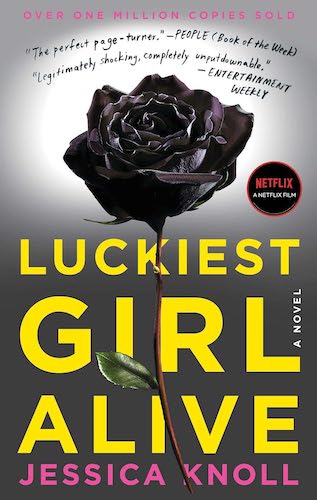
First I’ll share my thoughts on the book. Then I will discuss how it was adapted by author Jessica Knoll for a two-hour Netflix movie.
Luckiest Girl Alive has a surprisingly low Goodreads rating (3.54) for a bestselling book that was nominated for two Goodreads Choice awards. (Though, as I explained in my Best Books of 2022 post, I do side-eye those awards a bit.)
Some reviewers seem to suggest the low ratings are due to marketing. Apparently, Luckiest Girl Alive was pitched as the new Gone Girl. Which it really is not. I can see the comparison to Gillian Flynn, as Ani in this book does bear some resemblance to the hard-shelled but deeply traumatized girls in earlier Flynn books.
The other reason for the low ratings could be because while Luckiest Girl Alive is a very slow burn revenge story, it takes a while to figure out where the story is going.
I think some readers may have lost patience with Ani and the slow pace, though I felt the ending was worth the wait.
After a really catchy opening as main character Ani shops for knives for her wedding registry, the book slows way, way, way down, exploring Ani’s life as the fiancé of a rich WASPy finance guy.
She finalizes the font on her wedding invites, name drops designer brands, shit-talks other women, and is generally a character that many readers found completely unlikeable.

But as the book progresses, we learn Ani’s backstory. She was TifAni FaNeli (no, that’s not a typo) a scholarship girl at a boarding school who suffers a horrible, traumatic assault at a party.
In the present, Ani is participating in an HBO Documentary about … something, but we aren’t sure what.
If you haven’t read the book and want to, you might want to stop here and come back to this post after you are finished. There will be spoilers after this point!
The book then slowly and patiently alternates Ani wedding planning with truly harrowing scenes of her high school life, in which two of her friends, guys who were bullied by her assailants, proceed to set off homemade explosives in the cafeteria and then hunt down their tormentors one by one.
In the present, Ani is horrified to come face-to-face with one of her attackers, who was paralyzed in the shooting. He magnanimously says he will tell the cameras that Ani had nothing to do with that, but is unwilling to admit the part he played in her earlier assault. Furious, Ani gets her truth out there anyway. It’s an ending worth waiting for.
Review of the 2023 Netflix Movie Luckiest Girl Alive
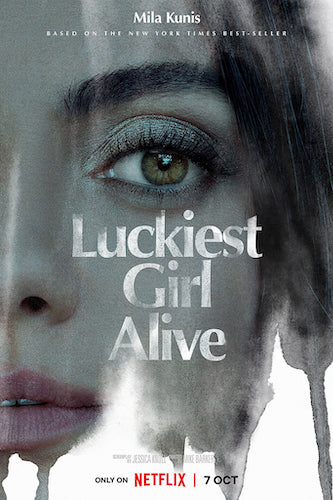
Was the book better, or the movie?
It was interesting to me that Jessica Knoll wrote the screenplay for the Netflix show. I thought the screenplay did a good job of restructuring the story to even out the pacing.
But I thought the book had a much stronger ending. I felt the movie made Ani out to be a pop culture feminist hero. In the book she seemed (to me) like a woman ready to get revenge and willing to burn everything down in the process. A woman who had ceased to care of what others thought of her, which was sort of the whole point. The book makes very clear that Ani needed all those superficial trappings (fiancé, ring, name brand clothes) to feel safe enough to finally speak out.
Was Luckiest Girl Alive Inspired by True Events?
The book’s moving acknowledgments explain that some events in the book are based on Knoll’s real life experiences. Like Ani, she suffered a horrific assault as a teen and then became a writer for a women’s magazine (Cosmopolitan, in Knoll’s case.)
In addition, it feels a bit “meta” to watch Mila Kunis play Ani, given the recent controversy surrounding her. This Vox article explains that the character letters she wrote referencing Masterson’s anti-drug work were not to assert his innocence, just to be taken into account during his sentencing. But many people were hurt and upset.
The whole controversy had an eerie parallel to the story of book (and movie) character Dean. One of Ani’s attackers, Dean is paralyzed in the school shooting. He then goes on to dedicate himself to the anti-gun cause, writing a book and doing public appearances. But Ani calls BS on his supposed rehabilitation, and proceeds to take him down. At the end of the movie, a woman on the street even accosts Ani about the piece. There’s a lot to unpack here and we need Ani-the-reporter to write us an article about it all.
That said, I thought Kunis did a great job in the role and made a perfect Ani.
Main Differences Between the Book of Luckiest Girl Alive and the Netflix Movie

In the book, Ani has already decided to participate in an HBO documentary. In the movie, Ani has been approached but has turned it down. When she learns Dean is participating, she changes her mind. I liked this change as, in the book, I was a bit confused as to why she said yes.
In the Netflix movie, the high school revenge plot is introduced much earlier. I preferred the approach of the book, but I see why the change was made.
Ani is questioned extensively by the police in the book in the aftermath of the school shooting. In the movie, this suspicion of her becomes just gossip and whispers as she tries to attend a classmate’s funeral.
Teacher Mr. Larson has a much larger role in the book. Ani spends a great deal of time with him in the present, but that is cut out of the movie. In the movie, Larson is fired for advocating for Ani with the school administration. In the book I think he leaves the school voluntarily.

To me, the most significant difference between book and movie is the ending.
In the book, Dean makes a furtive offer to Ani as they encounter each other during the documentary filming. He’ll reassure the world that she had nothing to do with the carnage in the school cafeteria. In return, he wants her to keep quiet about him assaulting her. This exchange is supposed to be just between the two of them, but they are still wearing microphones. Thus, it’s caught on tape and the HBO documentarian offers to put his confession in the film.
I’m not sure what the reason for the change would be. Was what the filmmaker did technically unethical?
In the movie, Ani gets Dean to confess in a school library after one of his anti-gun talks. She tapes his confession on her phone and then proceeds to write a NYT magazine piece about her assault, naming and shaming Dean.
The ending of the book and the movie had very different feels.
By the end of the book Ani struck me as a sadder-but-wiser character who breaks up with her fiancé during their wedding festivities because she realizes she doesn’t need him anymore. His WASPy affluence and confidence (and giant heirloom engagement ring) provided her the armor to finally confront those who wronged her.
In the movie, Ani’s fiancé Luke is annoyed that she doesn’t tell him that the NYT piece is coming out on the day of their engagement party (fair). Then Ani gives him a soggy “it’s not you, it’s me” speech. After that, she hops on the Nantucket ferry with her BFF Nell (played by Justine Lupe from Succession) and heads to her new job. In the movie, it felt to me that she was using Luke in a more calculated way.
Should You Read or Watch the Luckiest Girl? Or both?
First off, if you would find the content of either disturbing, then no. Some of those scenes were very hard to read (and watch).
Other than that, it’s a tough call between the two. The pacing of the book was off and Ani was more unlikeable, but if, like me, you are a fan of “burn it all down” female revenge stories, then read the book if you haven’t.
As explained above, the ending of the movie felt a little less emotional to me, with the revenge element a bit more dialed back. It was almost like Ani couldn’t do what she did just for herself, but had to do it for all women. But I was happy that the carbon monoxide analogy from the author’s afterword was incorporated into the movie.
Did you read the book when it came out and what did you think? Tell me in comments!
If you’re looking for other “Read and Watch” options check out my post on Books to Read (and Watch) for Book Club!