In August 2013, I interviewed Gabrielle Zevin for a blog hop called Authors are Rock Stars. I just dug up the interview and decided to re-publish it on here. She’s such a smart and fascinating person! Check out my Interview with Gabrielle Zevin!

Introduction:
What do I love about Gabrielle’s books? They are always original and unexpected. Always smart and filled with complicated characters, interesting premises, wit, and heart. Do you ever read a book and think that the author must be an absolutely fascinating person? That’s how I feel each time I read one of Gabrielle’s stories. Her unique take on the world shines through on every page. I’m so thrilled that she agreed to stop by and chat with me….
Interview with Gabrielle Zevin (August 2013)

Jen:
I’m so excited (and a little sad) that In the Age of Love and Chocolate, the final book in your fantastic Birthright trilogy, is coming out in October 2013. Did the book have a title change, because I’ve also seen it listed as In the Days of Death and Chocolate.

Gabrielle:
Thank you, and I’m so glad you like the series. The truth about the title change is that I wrote two entirely different books for the last book. The first time I wrote the book it was called In the Days of Death and Chocolate. That version was pretty deep into the publishing process when I began to have a recurring, waking dream about Anya Balanchine.
I kept having this fear that I would run into her and that she was mad at me. At first I tried to ignore her, but after a while, I couldn’t. I was at a party, and I actually thought I saw her across the room! That was a Saturday. On Sunday, I called my editor and I might have cried a little bit and I asked her if I could write the book again. She said yes, and now Anya Balanchine isn’t angry with me anymore.
The hard thing for me in writing (and probably in life) is to find the lightness in things. The difference between the two versions is probably contained in that sentiment.
Jen:
Speaking of lightness, I’m wondering whether In the Age of Love and Chocolate will have more love and less death. Poor Anya has been through a lot in the first two books — being a suspected murderer, undergoing a break-up, being sent to reform school, and then, uh, that incident in Mexico with the machete…
Now that Anya’s opening up a nightclub, will she get to have any fun?
Gabrielle:

Let’s talk about the “more love” part first. I spent a long time thinking about Anya and about Win before I started writing the third book again.
In All These Things I’ve Done, we only experience Win through Anya’s point-of-view, and the thing to know about book one Anya is that she is skeptical about love and thus she is skeptical about Win.
She does not present him as, say, Bella presents Edward. She has doubts. She sees him as a boy and often a silly one. She does not believe him when he says he loves her because how can someone like him, someone whose losses are so much less than hers, even know what love is? She, as a narrator, is incapable of romantic abandon.
So… I think the question of the third book in many ways is what does it take to make a person like Anya Balanchine, who has experienced so much loss and who really wants other things out of her life, believe in love?
I wanted to write a love story about what it means to love someone as an adult, in the absence of parental/societal obstacles and hormones, etc.? What does it mean to love someone who has made mistakes?
I kept thinking of that Shakespearean sonnet, “Love is not love which alters when it alteration finds. Oh no, it is an ever-fixed mark.”
I studied the sonnets in college and, to an extent, that particular sonnet is meant ironically. At this age in my life, I find the sonnet’s sentiment to be both true and untrue. Love that lasts has to be allowed to change. But I digress. You asked me about fun, right?
I think she does have fun in the third book and I think she really deserves it. But I don’t know if she is a girl who is constitutionally built for fun.
She worries too much. She wants to control things. She has too many responsibilities. But I loved writing the nightclub. I loved seeing Anya in a part of her life where she is allowed to kiss boys and dance and stay up late. I loved seeing Anya worry a little bit less.
Jen:
I’m glad! I was amazed to read on your blog that Anya was inspired by Anne of Green Gables.
I’m a huge fan of both Anne and Anya, but it’s hard to see any superficial similarities between them. Anne is a nineteenth-century orphan sent to live on a remote Canadian island, while Anya is the daughter of a notorious crime boss and lives in Manhattan in the year 2083. Can you tell us a little bit more about how Anne inspired the character of Anya?
Gabrielle:
There are series that are plot-based. For instance, The Hunger Games or Divergent. And there are stories that are character-based. Like Anne Shirley and Anya Balanchine. The world matters in my book to the extent that it defines Anya’s character and conflicts.
Really, Birthright is about a girl becoming a woman and a character moving from innocence to experience. It is a bildungsroman. The most rewarding part of writing the series for me has been living with this character so long, and seeing how much she’s grown up. When I look back at book one, I think that Anya seems like such a little girl in comparison to the person she is at the end.
But yes, I do think there are similarities. Anne and Anya are both orphans. They both have strong grandmother figures. They both endure terrible losses. They both, because of these losses, take a long time to figure out love.
In the third book, Anya’s relationship with Scarlet is very much modeled on Anne’s relationship with Diana Barry in Anne of the Island—we see what happens in friendships when women make different choices in their lives. And of course, I could also mention to you that Prince Edward Island and Manhattan are both islands!
Weirdly, I’m told that the books have been more popular in Canada and the US. So maybe they somehow sense the influence, I don’t know.
Jen:
I’ve always loved the way that Anya addresses the reader directly. (My favorite example is from Because It Is My Blood: “Reader, I do believe I snorted.”) That’s a technique that’s been used by some of my favorite nineteenth-century writers — like Charlotte Brontë — but not one that you see often in contemporary books. What made you decide to let Anya speak directly to us?
Gabrielle:
I’m glad you appreciated it though I will say that technique has proven pretty controversial with readers. (Indeed, much about Anya and the series has proven rather polarizing!)
But I did have a theory about using direct reader address. 2083 is a world without new books and without, particularly, readers either. Anya Balanchine is not a reader, and the only stories she has been exposed to are the ones she happens to have read for school or the ones Imogen reads to Nana.
Anya’s ideas of storytelling are classic and old-fashioned because that really is all she’s been exposed to. Direct reader address is a common technique in the earliest novels and a lot of the novels I love – I think of Jane Eyre or David Copperfield.
The other answer is that, Anya’s future is, by design, a retro-future — technology has stagnated, clothing production and publishing has largely stopped, things are getting worse in the 2080s. And I thought using classical novel writing techniques would best reflect the larger societal issues.
It’s interesting to consider why readers find direct reader address so troubling. All stories are told/being told to someone. Anya is such a self-aware character, almost paranoid at times. Of course she knows YOU (the reader) are there.
I felt breaking the fourth wall suited her character, which is suspicious and usually on the wrong side of law. (You’ll notice she breaks the fourth wall a lot less when she is on the right side of the law in the third book.)
Jen:
Another thing I love about this series is the setting — I find your vision of a futuristic New York completely fascinating. I loved this video that you did as part of the promotion for All These Things I’ve Done. In it, you take the reader on a short tour of some of the New York settings that appear in the book. Can you describe some of the places that inspired you in In the Age of Love and Chocolate?
Gabrielle:
Thank you! The video was incredibly fun to make, and I watch it with a little sadness since I moved to California about a year ago.
In terms of locations for the third book? A great deal of the first part takes place at the former site of the New York Public Library for reasons readers of Because It Is My Blood will already know. And there is also a part in the Russian Orthodox Cathedral in Brooklyn – though it is a church, the reason Anya goes there has nothing to do with church.
Anya does however get to leave the city quite a lot in the book, and there’s an extended part on a farm on the Mohawk River in upstate New York, which is not far from where I was born. (This is probably my favorite part in the book.)
There’s a long part at a semi-feudal estate in Osaka, Japan. Several years ago, my novel, Memoirs of a Teenage Amnesiac, was turned into a Japanese movie and a great deal of the character of Yuji Ono and the Japanese parts of the third book are inspired by my experiences with the film.
Because of her work, Anya sees a lot of America in the third book – everything from Hershey, Pennsylvania to Alcatraz Island to the dorm rooms at MIT.
The book returns to Mexico for a bit, too. I lived in Florida as a kid, so we took several vacations to Mexico, because it was convenient. Also, one of my dearest friends growing up was from Mexico, and the way Theo talks (super fast, super smart, super funny; a little mean, but lovable) was modeled on her. Anyhow, I have always loved Mexico.
One of the most important things to me in writing the series was to show a young woman who is influenced for the better by travel and by exposure to cultures other than her own. We sometimes have the notion that people live as we do everywhere in the world, and that is not true and also, incredibly destructive.
I really liked The Hunger Games, but there is no sense of a world outside of Panem, which is America. I think it is important for young people especially to consider the greater world. Anyhow, that’s my two cents.
Jen:
With Anya’s story coming to an end, can you tell us anything about your future projects? I think you may have an adult novel coming out next year, and would love to hear about that and any new YA you have in the works.
Gabrielle:
I’m taking a little break from writing Young Adult. I’ve been writing YA for about ten years, and I always knew there might come a year when I ran out of stories about teenage characters, and that time has come.
You know, A LOT of books are published every year, and I’m not sure anyone needs another book by Gabrielle Zevin, unless it’s something I really believe in. However, I’m at this very moment working on another project that may be related to Anya Balanchine, but I can’t talk about it yet.
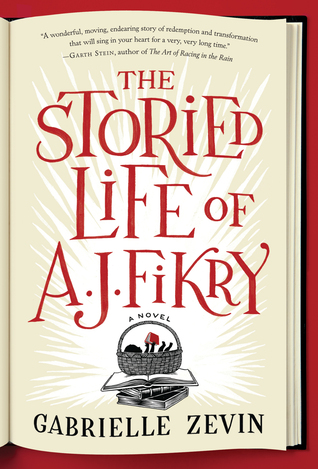
And yes, I do have an adult novel coming out in March, but I think it’s something readers of all ages might enjoy. It’s called The Storied Life of A.J. Fikry, and it’s about a girl abandoned in a bookstore.
Jen:
What could be better than a story set in a bookstore? Thanks so much for stopping by — it was my absolute pleasure to host you and I can’t wait to read In the Age of Love and Chocolate!
Gabrielle:
Thank you! These really were thoughtful and unusual questions, and they were a blast to answer. Also, I can’t wait for you to read In the Age of Love and Chocolate – it’s my favorite of the series, for what such distinctions are worth.